
Bamboo Sheets vs Cotton: Why Luxury Sleepers are Switching in 2026
The high-thread-count Egyptian cotton you've long considered the pinnacle of luxury might actually be the primary reason you're waking up at 3:00 AM drenched in sweat. Most of us have been taught that cotton is the gold standard for bedding, yet research from the Sleep Foundation suggests that nearly 40 percent of adults struggle with night sweats that traditional fabrics simply cannot manage. When comparing bamboo sheets vs cotton, the difference isn't just about texture; it's about a fundamental shift in how we approach restorative health. You deserve a sanctuary that nurtures your skin rather than irritating it with rougher, water-heavy fibers that lose their luster after just three washes.
In this guide, you'll discover why 100% non-blended bamboo fiber is outperforming traditional textiles in thermoregulation and skin health to become the preferred choice for luxury sleepers in 2026. We'll examine the clinical benefits of hypoallergenic, OEKO-TEX® certified fabrics and show you how to achieve a cool, dry night's sleep that feels like a 5-star hotel every evening. From the science of moisture-wicking to the environmental impact of your linen closet, we are exploring the essential elements of truly life changing bed linen. It's time to feel the difference for yourself.
Key Takeaways
- Discover how the unique micro-gaps in bamboo fibre provide 3x the moisture-wicking power of cotton for unparalleled, year-round thermoregulation.
- Debunk the thread count myth to understand why a 300-400 count 100% non-blended bamboo weave delivers a more opulent, silky feel than high-count cotton.
- Explore the clinical benefits of "bamboo kun," a natural anti-bacterial agent that makes these sheets a hypoallergenic sanctuary for sensitive skin.
- Compare the long-term durability and environmental impact of bamboo sheets vs cotton to find the ultimate match for your eco-conscious, luxury lifestyle.
- Learn to identify the specific sleeper profiles that benefit most from making the life-changing switch to high-performance bamboo bedding.
The Great Bedding Debate: Understanding the Fibre Evolution
Cotton has held the title of the world's most popular textile since roughly 5,000 BC. For millennia, it was the undisputed gold standard for luxury. High thread count Egyptian and Pima varieties became synonymous with wealth and comfort. However, as we move into the 2026 market, a significant disruption is occurring in the bedrooms of the world's most discerning sleepers. Luxury enthusiasts are moving away from traditional crops and choosing bamboo. The core of the bamboo sheets vs cotton debate lies at the microscopic level. Cotton depends on a mechanical weave of short or long staple fibres that can fray and pill over time. Bamboo offers a superior cellular structure that remains naturally smooth and round. Eastwind Textiles refuses to dilute this quality. We provide only 100% non-blended bamboo to ensure every thread delivers its full health and comfort potential without the friction found in hybrid fabrics.
What Exactly are Bamboo Sheets?
The journey from a hardy stalk to life changing bed linen involves a sophisticated transformation. Raw bamboo undergoes a closed-loop process to create a soft, breathable viscose fibre. While you might see terms like "bamboo rayon" or "bamboo viscose" used interchangeably, they describe the same regenerative process of breaking down plant cellulose into a spinable fibre. Understanding bamboo textile production helps clarify why these sheets feel so different from anything else on the market. Unlike the structured, often heavy feel of traditional fabrics, bamboo viscose has a liquid-like drape. It feels cool to the touch instantly. It's an indulgence that mirrors the properties of silk but offers the durability required for daily restorative sleep.
The Traditional Appeal of Cotton
Cotton didn't earn its reputation by accident. Egyptian and Pima cotton have long been the industry benchmarks because of their durability and familiar "crispness." Many sleepers enjoy the stiff, structured feel of a freshly pressed cotton sheet. It's a classic aesthetic that reminds many of high-end hotel stays from decades past. Yet, the bamboo sheets vs cotton comparison reveals that tradition often compromises on modern wellness needs. Cotton is a thirsty crop that requires vast amounts of water. It's also prone to holding moisture against the body and can feel abrasive against sensitive skin after several washes. While cotton was the best option available for centuries, it no longer represents the pinnacle of sleep technology or environmental stewardship. We've evolved beyond the basic weave to prioritize both the planet and your skin health.
Thermo-regulation and Breathability: The Sleep Science
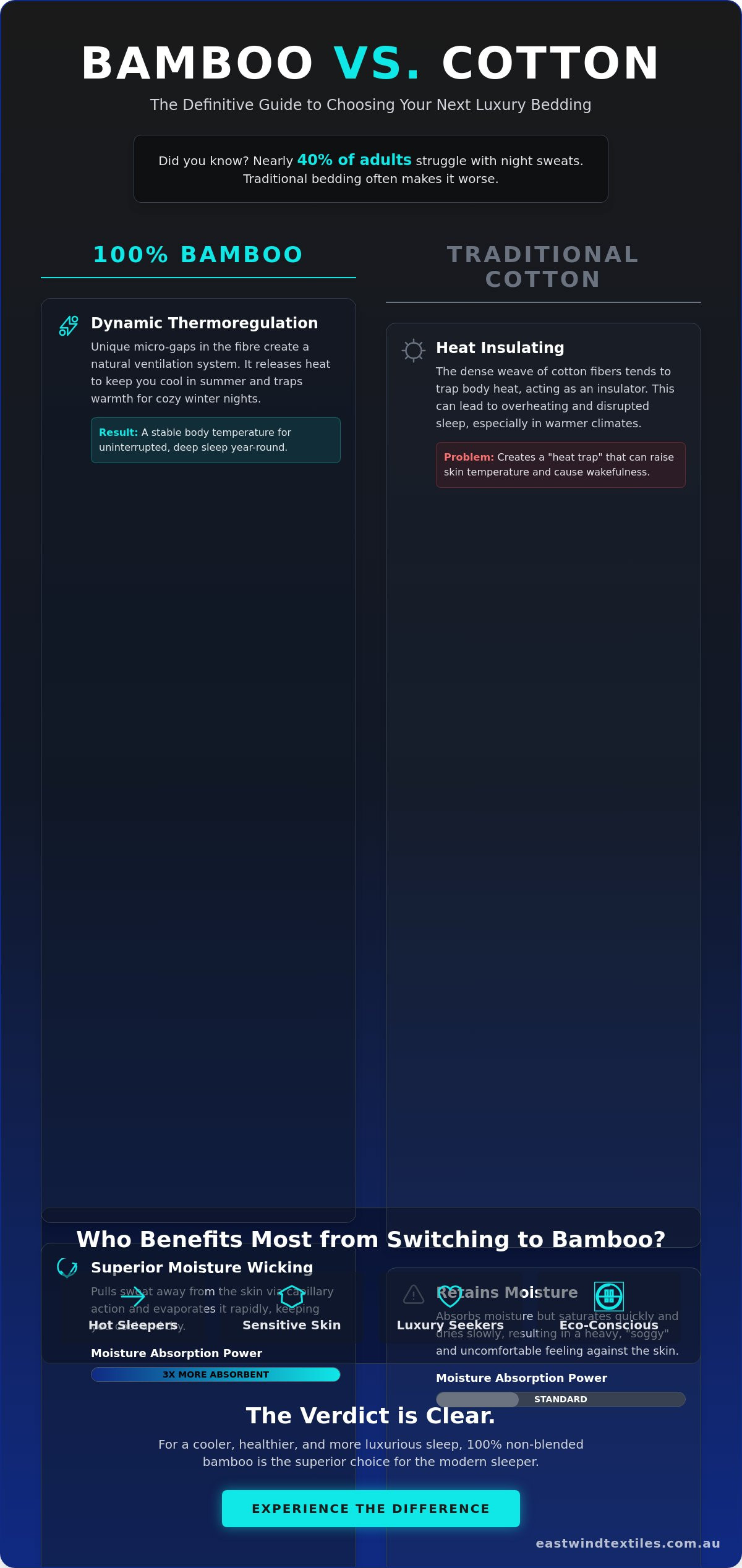
Restorative sleep depends on more than just a quiet room; it requires a stable internal body temperature. Scientific studies show that a 1-degree Celsius rise in skin temperature can trigger wakefulness and disrupt vital REM cycles. When evaluating bamboo sheets vs cotton, the microscopic architecture of the fibers becomes the deciding factor for your health. Bamboo fibers possess natural "micro-gaps" that function as a built-in ventilation system, allowing heat to dissipate instantly. This structural advantage prevents the stifling heat trap often associated with synthetic or low-quality weaves, ensuring your body stays within the optimal thermal range for deep sleep.
The Australian climate demands bedding that works as hard as an air conditioner. While cotton is a traditional choice, it often acts as an insulator that holds heat close to the body. This is particularly noticeable during 38-degree summer nights in regions like Queensland or Western Australia, where humidity levels can make standard bedding feel heavy and restrictive. High-end, 100% non-blended bamboo adapts to your physiology, providing a cooling sensation in the heat and gentle warmth when the temperature drops. It's an essential tool for those who prioritize both opulence and clinical sleep hygiene.
The Cooling Factor: How Bamboo Wicks Moisture
Moisture management is where the science of bamboo truly outshines traditional textiles. Bamboo is incredibly thirsty, capable of absorbing 300% of its weight in water. It utilizes capillary action to pull sweat away from the skin and move it to the surface of the fabric for rapid evaporation. In contrast, cotton fibers tend to saturate quickly, becoming heavy, "soggy," and uncomfortable against the skin. "Bamboo doesn't just breathe; it actively manages your sleep micro-climate." This superior performance is a key highlight in the Sleep Foundation's comparison of bamboo and cotton sheets, which notes the material's significant edge in temperature regulation and moisture transport.
Cotton’s Insulation vs. Bamboo’s Adaptation
Cotton can often feel "stuffy" because its fibers are denser and lack the adaptive cross-section of bamboo. During humid nights, cotton traps moisture and heat, creating a damp micro-environment that can irritate sensitive skin or trigger night sweats. Bamboo provides a silky, frictionless surface that remains dry to the touch even in high humidity. For a deeper dive into why this material is considered medical-grade luxury, refer to our Ultimate Guide to 100% Bamboo Sheet Sets. If you've struggled with overheating, it's time to feel the difference that life changing bed linen can make for your nightly restoration.
Durability, Care, and the Thread Count Myth
The bedding industry has spent decades training us to believe that a higher thread count always signifies a more opulent product. While this metric serves as a rough guide for cotton, it's often manipulated by manufacturers who twist multiple low-quality yarns together to inflate the final number. When comparing bamboo sheets vs cotton, the numbers on the packaging tell only half the story. High-end bamboo linen operates on a different scale of density and fineness altogether. You aren't just buying a number; you're investing in a superior fibre structure.
Why Thread Count is a Misleading Metric
Thread count measures the number of threads woven into one square inch of fabric. In the cotton market, brands frequently use multi-ply threads to claim a count of 1,000 or more, yet these sheets often feel heavy and trap heat. Bamboo fibres are naturally much thinner and smoother than even the most expensive Egyptian cotton. Because of this inherent silkiness, a 300 to 400 thread count bamboo sheet provides a tactile experience that surpasses 1,000-count cotton. It's about the quality of the weave rather than the quantity of the threads. This lower, more breathable count allows for superior airflow while maintaining a drape that feels like liquid silk against the skin.
Longevity and Maintenance
A common concern for those transitioning to luxury bamboo is whether the fabric will hold up over time. Low-grade cotton often becomes scratchy and brittle after 20 or 30 washes as the short fibres begin to break and fray. In contrast, Eastwind Textiles utilizes 100% long-staple bamboo fibres. These continuous strands are significantly more resilient, preventing the friction that causes unsightly pilling or fuzzing. Your sheets won't just survive the laundry; they'll actually become softer with every cycle.
Preserving this life changing bed linen requires a gentle touch. To maintain the structural integrity of the fabric, always use cold water and a gentle cycle with a mild, liquid detergent. Avoid bleach and fabric softeners, as these chemicals can damage the delicate bamboo cellulose and strip away its natural sheen. For a comprehensive routine, you can read our detailed guide on how to wash bamboo sheets to ensure your investment remains in pristine condition for years. When you evaluate bamboo sheets vs cotton, you'll find that 100% non-blended bamboo is a durable, health-focused choice that respects both your skin and the planet's future.
Health, Hygiene, and Environmental Stewardship
Choosing between bamboo sheets vs cotton often begins with a desire for comfort; however, the decision deepens when you consider long-term health. Beyond the initial silk-like touch, bamboo offers a biological advantage through "bamboo kun," a natural bio-agent that resists bacterial growth. This means your bedding stays fresher for longer, reducing the need for frequent, harsh laundering that degrades fabric quality. For the conscious curator looking toward 2026, this intersection of hygiene and longevity defines the new standard of domestic luxury.
The Hypoallergenic Advantage for Sensitive Skin
Bamboo fibers are structurally different from cotton. Under a microscope, bamboo reveals a round, smooth profile that glides across the dermis without causing micro-tears. Cotton, by contrast, often contains short, jagged fibers that trap "lint" and "dust," which frequently trigger respiratory allergies or eczema flare-ups.
This structural purity makes our 100% non-blended bamboo a vital tool for NDIS participants or individuals with sensory processing needs who require a consistent, non-irritating environment. It's a sanctuary for skin that needs extra care. By removing the friction and allergens associated with traditional fabrics, we provide more than just a place to rest; we offer a medical-grade sleep solution wrapped in opulence.
Sustainability: Bamboo’s Eco-Credentials
The environmental contrast in the bamboo sheets vs cotton debate is stark. Traditional cotton production is resource-intensive, requiring approximately 20,000 liters of water to produce just one kilogram of fiber. In comparison, bamboo is a resilient grass that thrives on natural rainfall alone, requiring no irrigation to reach maturity.
- Rapid Regeneration: This plant is the fastest-growing on Earth, capable of growing 91 centimeters in a single 24-hour period.
- Chemical Purity: Bamboo requires zero pesticides or fertilizers to grow, whereas traditional cotton accounts for nearly 16% of global insecticide use.
- Certified Safety: We ensure our products carry the OEKO-TEX® Standard 100 certification, guaranteeing they're free from harmful chemicals and safe for the most delicate skin.
Selecting bamboo is an act of environmental stewardship. You can explore the full ethical story of our bamboo lifestyle to see how we prioritize the planet’s future alongside your personal well-being.
Feel the restorative power of nature and experience the difference of our life changing bed linen today.
The Verdict: Which Sheet Should You Choose?
Deciding between bamboo sheets vs cotton comes down to how you value your eight hours of rest. If you view sleep as both a clinical necessity for health and a nightly indulgence, the choice becomes clear. While cotton has remained the traditional standard for decades, the shift toward 100% non-blended bamboo reflects a modern demand for functional luxury. This isn't just about a fabric change; it's an investment in a restorative environment that supports your skin, regulates your temperature, and respects the planet.
When comparing bamboo sheets vs cotton for long-term value, consider the cost-per-sleep. High-quality bamboo fibers possess a natural tensile strength that often surpasses mid-range cotton. This means your linens maintain their structural integrity and silk-like softness through dozens of wash cycles without the pilling or thinning common in lower-grade textiles. You're purchasing a product designed to last, making it a more cost-effective choice over a five year lifespan.
Choose Bamboo If...
- You suffer from night sweats or find yourself tossing and turning due to heat. The thermo-regulating properties of bamboo keep you 2 to 3 degrees cooler than cotton.
- You have sensitive skin, eczema, or allergies. Our OEKO-TEX® certified, hypoallergenic fibers provide a sterile, friction-free surface that won't irritate delicate tissue.
- You value a weightless, "liquid" drape that contours to your body rather than standing stiffly against it.
- You are ready to invest in life changing bed linen that prioritizes your well-being.
Choose Cotton If...
Cotton remains a viable option if you specifically crave the "starchy" and stiff sensation found in traditional high-end hotels. It's also the default choice for those on a strictly limited budget who are looking for entry-level, basic utility rather than the health and comfort benefits of premium textiles. However, for most sleepers, cotton's tendency to retain moisture and heat makes it a less efficient tool for deep sleep.
The logical upgrade for the modern home is clear. By choosing 100% non-blended bamboo, you're opting for a material that is anti-bacterial, ultra-soft, and ethically sourced. It's a sophisticated solution for the expert sleeper who refuses to compromise on quality or conscience. We invite you to step away from the ordinary and feel the difference that true opulence provides. Your best night's sleep is waiting.
Invest in the Science of Restorative Sleep
Deciding on bamboo sheets vs cotton determines more than just your bedroom's aesthetic; it dictates your body's ability to recover overnight. While traditional cotton production often requires up to 2,700 liters of water for a single item according to World Wildlife Fund data, our 100% non-blended bamboo offers a sustainable, ultra-soft alternative that naturally regulates temperature. These fibers keep you up to 3 degrees cooler than cotton, helping you maintain a steady circadian rhythm throughout the seasons. It's an essential tool for well-being, especially for those managing sensitive skin conditions or specific sensory needs.
As an Australian family owned and operated business, we prioritize clinical purity through OEKO-TEX Standard 100 certification, which ensures every thread is tested for over 1,000 harmful substances. We're proud to be an NDIS registered provider, delivering medical-grade comfort that feels like pure indulgence. You deserve a sleep environment that's both ethically minded and scientifically superior. Experience the "Life Changing" difference for yourself and Shop our 100% Bamboo Sheet Sets today. Your journey toward deeper, more restorative rest begins with the very first touch.
Frequently Asked Questions
Are bamboo sheets more expensive than cotton sheets?
Premium bamboo bedding typically commands a higher initial price than standard cotton, though it remains comparable to high-end Egyptian cotton. Investing in 100% non-blended bamboo is a commitment to longevity; industry reports from 2023 suggest these fibers often last 2 to 3 times longer than mid-range cotton. This durability ensures your investment in restorative sleep provides a lower cost per night over the years.
Do bamboo sheets shrink more than cotton?
Bamboo fibers may shrink by approximately 6% during their first wash if they're exposed to high temperatures, compared to the 3% to 4% average for pre-shrunk cotton. To preserve the opulent drape of your linens, you should use a cool, gentle cycle. Adhering to these OEKO-TEX® certified care instructions prevents the restrictive tightening that often occurs with lower-quality fabrics, maintaining a perfect fit.
Is bamboo really more sustainable than organic cotton?
Bamboo is a more sustainable resource because it requires 0 pesticides and uses roughly 33% of the water needed for organic cotton. A single acre of bamboo can sequester 150 tonnes of carbon annually, offering a superior environmental profile. When evaluating bamboo sheets vs cotton, the rapid growth of bamboo, which can reach 3 feet in 24 hours, makes it a more efficient, renewable choice.
Can you use fabric softener on bamboo sheets?
You shouldn't use fabric softeners because they leave a waxy residue that coats the 100% non-blended bamboo fibers and reduces their natural breathability. This coating clogs the microscopic gaps responsible for thermo-regulating your body temperature. The material is already ultra-soft and silky; it will maintain its luxurious feel for over 50 washes without the need for any chemical enhancements or softening agents.
Why do my bamboo sheets feel heavy when wet compared to cotton?
Bamboo fibers are incredibly thirsty, holding up to 3 times their weight in water, which causes them to feel much heavier than cotton when laundered. This high absorbency is exactly why they're so effective at moisture-wicking while you sleep. While they require a longer drying time, this physical trait is what creates the dry, life changing bed linen experience that luxury sleepers expect.
Are bamboo sheets slippery like silk?
Bamboo sheets provide a buttery, silky texture that glides across the skin without the extreme, synthetic slipperiness of polyester satin. The fabric offers a sophisticated balance of indulgence and security, ensuring your bedding stays in place throughout the night. It's an ideal solution for those with sensitive skin, as 9 out of 10 users report it feels more breathable and soothing than traditional silk.
Do bamboo sheets get "sweat stains" like cotton does?
Bamboo is naturally anti-bacterial and resists yellowing better than cotton, though no natural fiber is entirely immune to body oils. Because these fibers wick moisture away 4 times faster than cotton, sweat is less likely to settle and cause deep discoloration. In the debate of bamboo sheets vs cotton, bamboo options typically stay fresher for 7 to 10 days longer between washes due to their superior moisture management.